Average Reviews:

(More customer reviews)I like Hatmaker and enjoy his easy writing style and ability to simplify fighting concepts. This book is a nice catalog of takedowns for someone who is used to stand up fights and wants to learn how to take his opponent to the mat. Boxer, kick boxers and karate grounded guys can see a wide range of techniques.
Wrestlers and soft martial arts guys, judo and jujitsu, may pick up a technique here and there, but most of the book really misses this group. The philosophy for a lot of the set ups for the takedown techniques seemed based on a sparring or jabbing model. The opponent's balance is disturbed by a sudden jab like push, pull or grab of some kind which is then abandoned so you can follow up with usually a double leg takedown -- though many other takedowns are considered later in the book. The problem I have with this model is that it won't work with "sticky" opponents.
Unlike boxers who spar, soft martial arts guys often welcome an opponent's push, pull or grab as an opportunity. They hold on to attacking hand/limb while they they yield to momentum of the attacker and then redirect his attack to their advantage. It feels like your hand hit glue on a swinging door. These set ups calling for a jabbing attack can end up being used to off balance the attacker. Of course, if you limit yourself to inexperienced opponents or boxer type opponents, this shouldn't be a problem.
This book would benefit from something like a strategy section. While the subject is briefly addressed in choosing a stance, vertical versus bent over and wide base versus normal base, it is not discussed in how to deal with varied opponents. The author states such a book is in the planning, and I look forward to reading it. But with this book, clearly one shoe does not fit all feet. Most soft martial arts guys are going to be more vertical than lean in boxers and wrestlers. In the same vein, different takedowns will work for wide based stances than normal shoulder width apart stances -- square versus staggered foot stances. Tailoring the takedowns to different opponents seems just as important as selecting your own stance.
Two specific weaknesses: Nothing was said about learning how to fall safely. A few pages would have gone a long way to insure guys without any background in landing on their backs from a standing position not get hurt. Most guys do something stupid like reaching back while falling and risk injuring the joints of their arms or cracking their necks (chin to chest when going down.) Second, some of the less used takedowns shown in the book are clearly not neck friendly and inexperienced guys should be very careful with them if they are going directly from the book to their backyad with a hapless buddy.
Good book for non grapplers who want to see what takedowns look like. But expect that quite a bit of fine tuning will be necessary for the techniques to actually work.
Click Here to see more reviews about: No Holds Barred Fighting: Takedowns: Throws, Trips, Drops and Slams for NHB Competition and Street Defense (No Holds Barred Fighting series)
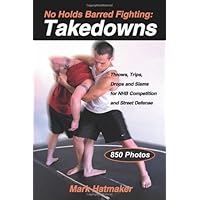
This fourth No Holds Barred Fighting training manual contains all fighters need to know about the art of takedowns, or "shooting," and how to counter takedown tactics used by an opponent. Readers learn to see it from both sides with offensive and defensive stances, footwork, setups, and shooting techniques. Several variations of the most commonly employed shots are featured-double leg takedowns, single leg takedowns, snatch singles, and low singles-as well as counters for each. Hundreds of sequential photos illustrate the steps, grips, and angles of every move, and takedowns are included for use inside the inevitable clinch. Sections on drills and chains, as well as a list of resources for further practice, round out the text.
 Get 15% OFF

No comments:
Post a Comment