Average Reviews:

(More customer reviews)Those of us in the physical therapy, personal and performance training, coaching, strength and conditioning, and other physical activity related fields know the importance of continuing education, and Anatomy Trains provides a refreshing look at how things actually work in comparison to half-of-the-story as provided by most text books.
Anatomy is taught in isolated motion. No one moves strictly in isolated motion in anything pertaining to every day life. This book provides the theory as well as dissection evidence to give credibility to the arguement that those of us in our field need to be more open minded to treatment outside the realm of strict anatomical interpretation. The problem there lies more in America's fixation with treating the problem, but not addressing the cause. Its not just the professional's fault for this, but the client's uneducation or miseducation.
When a client comes in to get a massage because they're back is tight, a massage therapist treats the back. It doesn't matter if the cause is actually a tight lower SFL causing anterior pelvic tilt then causing compensation in the SBL for the back pain; the back is still what the professional treats. Most of the time, it isn't the professional's fault for not knowing; it isn't taught in most schools.
Anatomy Trains is a great tool to show the benefits of progressive thought and prehab to prevent injuries in our clients and do a better job. Knowing how to fix is what we know, but knowing how to prevent is what we SHOULD know.
Click Here to see more reviews about: Anatomy Trains: Myofascial Meridians for Manual and Movement Therapists
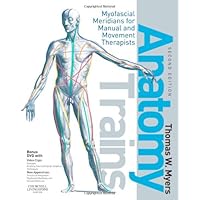
Understanding the role of fascia in healthy movement and postural distortion is of vital importance to bodyworkers and movement therapists. Anatomy Trains: Myofascial Meridians for Manual and Movement Therapists presents a unique 'whole systems' view of myofascial/locomotor anatomy in which the bodywide connections among the muscles within the fascial net are described in detail for the first time. Using the metaphor of railway or train lines, Myers explains how patterns of strain communicate through the myofascial 'webbing', contributing to postural compensation and movement stability. Written in a style that makes it easy to understand and apply, Anatomy Trains provides an accessible and comprehensive explanation of the anatomy and function of the myofascial system in the body.The DVD ROM in the back of the book contains video of techniques, Anatomy Trains-based dissections and computer animations of the myofascial meridian lines.includes full-colour illustrations of 11 myofascial meridians and the rules for discovering other meridians.uses numerous full colour charts and drawings to detail the muscular and fascial structures involved in the meridians.presents information on assessment of structural and movement patterns and gives related application to manual therapy and movement education.provides a selection of techniques from the library of structural integration.includes an introduction to the fascial system as a whole, with points-of-view and the latest research findings on the fascial system's responses.offers a fun approach to learning essential structural anatomy, comparing the connective tissue system to a railway network.video material on the accompanying DVD ROM to visually present the anatomy as described in the book.Full colour throughout.New design and layout.140 New full colour figures including dissection photographs and client photos.DVD ROM in back of book.A new appendices on 'Structural integration' and 'Myofascial meridians and oriental medicine'.New posters to be published simultaneously.
 Get 25% OFF

No comments:
Post a Comment