Average Reviews:

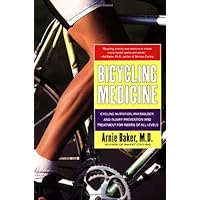
(More customer reviews)So many books on cycling health or training start with an assumption that your last name is Merckx, Armstrong or LeMond. Biking is, in my opinion, the most excellent way for someone overweight and in poor cardiovascular health to get into shape, as few other activities allow someone to ease into better performance. Being one of those people, I was persuaded to buy Bicycling Medicine because the subtitle said "for riders of all levels." This book is true to its title.
The author, Arnie Baker, is a physician, a competitive cyclist and cycling coach. I liked his very conservative view of medicine. He does not hype techniques and products, and gives a balanced view of advantages and disadvantages of the subjects. (After reading the effects of too much vitamins, you will probably not want to take supplements again.) He honestly discusses the limitations of medicine and medical testing.
The book is divided into five parts, and further divided into 81 mini-chapters. Each chapter tackles one subject in a succinct manner - short, easy, but adequate. Most chapters starts with "What We're Talking About" that introduces and defines the subject before delving more deeply into it. Some of the subjects are nutrition, energy use vs. effort, vitamins, performance aids, heart rate training, muscle physiology, optimum cycle fit, injury treatments, medical problems and general health. The range of topics covered is simply astounding. Baker even discusses how to urinate while riding, which side of your body is best to sleep on, and how to shave your legs. He discusses gender-specific topics honestly and maturely, as you would expect from a physician.
The book is sparesly illustrated, and does not require many additional figures, but if you need lots of glossy photos of racers cutting through corners to keep your attention, you won't find them here. Most of the figures in the books are of a cartoon character demonstrating a very complete array of stretching exercises.
My complaints are very few, and are to be considered more of suggestions for later editions. A couple of additional figures could be helpful in the bike fitting sections. I was a little confused by "...angle from the horizontal formed by the knee at the bottom on the pedal stroke." (p.119) I think I get it, but I'm still not quite sure. "Handlebar angle" on p.149 could have been illustrated. On p. 97, energy and power are confused. This is important to an engineer such as myself, and I think the author understands it, too, but got lazy at this point with the terminology (work is energy and is therefore not measured in Watts, which is power). On pp. 110-111, while I understand efficiency very well, I am kind of lost by his definition of economy. And the related example confuses me more. Is economy energy per distance, or energy per speed? "Fewer calories are needed to travel at the same speed" doesn't make total sense without establishing the distance over which the speed was maintained. Figure 1-4 has "Low," "Medium," and "High" exercise intensities on the x-axis of the graph, and in the text he defines these as 65%, 75% and 90% of maximum heart rate. Why not just put those value on the graph?
Again, I consider these complaints minor.
I recommend this book to everyone who is beginning cycling and wants to cycle for fitness, or has any desire to measure and improve his performance. It is a fantastic starting point. After reading this book, you will have enough understanding to ask other questions or to seek out more in-depth resources on the subjects that interest you most. Someone with years of cycling involving some sort of training may find the book somewhat basic, though, but it may still be a useful, very general, reference.
Click Here to see more reviews about: Bicycling Medicine: Cycling Nutrition, Physiology, Injury Prevention and Treatment For Riders of All Levels
 Get 27% OFF

No comments:
Post a Comment