Average Reviews:

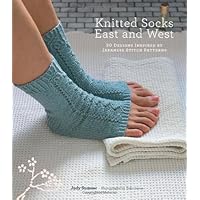
(More customer reviews)This is a sock book for experience sock knitters or those looking for a challenge. Most of the patterns involve following a complex graph that spans 10-21 stitches and 15-30 rows. The socks require many different techniques, such as bobbles, cables, traveling stitch, lacework, wrapping groups of stitches and several techniques that will be new to most western knitters (pkok, twist/slip, and three-stitch lift). Most of this socks will look best with solid or nearly solid yarn to show off the complex stitches, although some of the all lace ones would be quite interesting with a variegated yarn. All but one of the socks is intended for women, with one pair written for men, and another written for both an adult and child. This are all standard socks, except for the one pedicure style pictured on the cover, a yoga sock, a leg warmer and a toe sock.
If you are a fan of complex socks, such as those of Cookie A, as I am, then you will love this book. My one criticism is that many of the socks would only fit a very large foot as written. The author noted that due to the large repeats she could only write them for one size but stated that they were really stretchy so they would fit most feet. Oddly she choose to make that one stretchy size for quite a few socks 8.5" circumference and a 10.5" length, and even a pair of leg warmers that are 9.5" at the narrowest point. This explains why most of the socks look so terrible on the model's feet, bagging and sagging everywhere. In comparison, a typical medium sized women's sock is usually knitted to 7-8" circumference and a 9-9.25 length. Many of this socks would benefit from a small stitch gauge, so resizing by going down needle sizes should work fine. Many of the socks are written to a 7.5" circumference that will work for most women's feet.
Click Here to see more reviews about: Knitted Socks East and West: 30 Designs Inspired by Japanese Stitch Patterns
In Knitted Socks East and West, author Judy Sumner compares knitting a sock to writing a haiku: both challenge you to create something beautiful and original within a sparse, strict format. In this, her first book, she recounts how she came to study hundreds of exquisite Japanese stitch patters and then apply her new knowledge to the sock designs showcased here.
 Get 37% OFF

No comments:
Post a Comment